
AI-POWERED VENDOR MANAGEMENET

From need  to offboarding

In a single system Fluenta One makes your entire vendor portfolio transparent, automates repetitive review tasks, and supports every decision with objective data.

integrations icon
WHY FLUENTA ONE?

Phase by phase -without interruption

A vendor lifecycle can only operate efficiently when data flows automatically and seamlessly between phases. Fluenta One ensures this through three principles:

FULL DATA
CONTINUITY

Every stage of the vendor lifecycle takes place within a single system, so the same data is available from vendor qualification through onboarding — no duplication, no manual handoffs.

PROACTIVE RISK MANAGEMENT

The system continuously monitors vendor relationships and predicts changing trends. Risks and deviations are automatically identified — enabling early intervention before they have any business impact.

DATA-DRIVEN DECISION-MAKING

Every decision is grounded in continuously updated, objective data — negotiations, evaluations, and offboardings are fully documented and traceable.

deal tracking
vENDOR HUB

Vendor HUB -
all vendors on one platform

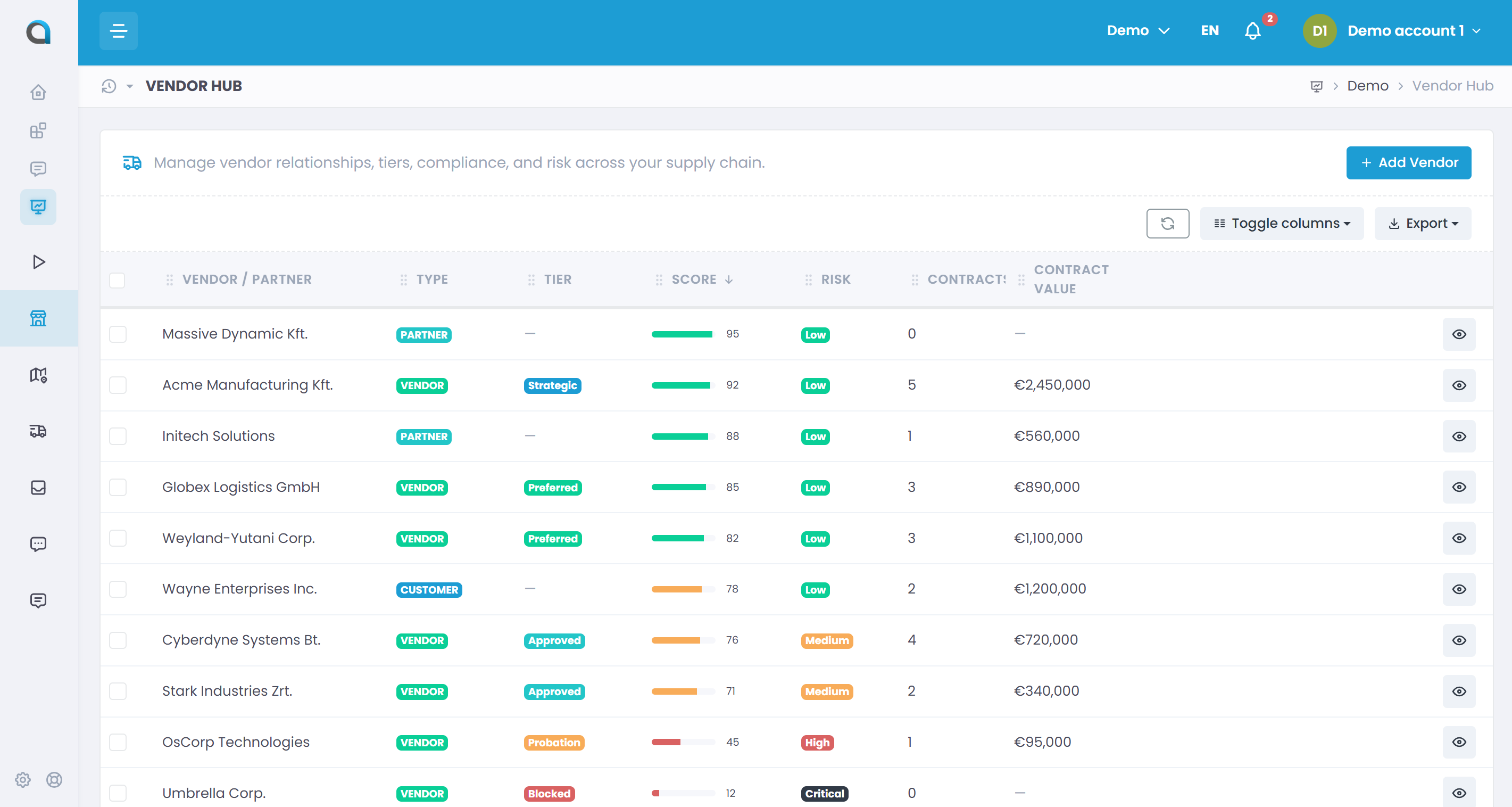
The Vendor Hub is the operational workspace where your entire vendor portfolio is visible in a single filterable view.
user information icon

Filterable list view

By type, risk level, contract value, and live score

deal tracking

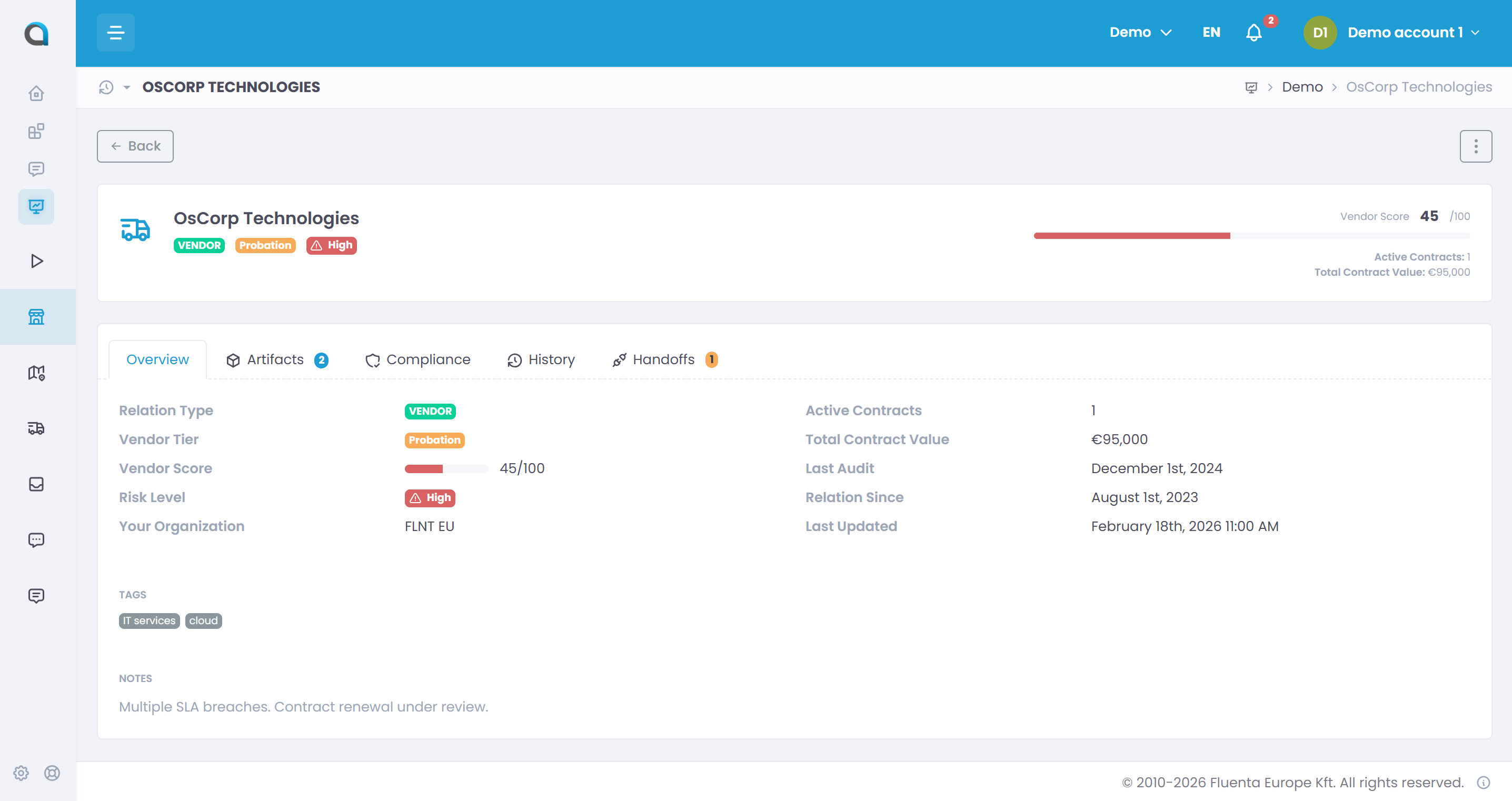
Complete vendor profile

Documents, history, contracts, and handoffs in one place

pipeline management

Vendor Landscape Map

Portfolio visualization by complexity and strategic importance

user information icon

Linked data objects

All data tied to a single vendor identifier across the full lifecycle

deal tracking
VENDOR LIFECYCLE

7 phases of the vendor lifecycle -with uninterrupted data flow

Automatic data flow between phases. Information captured once — supplier data, contract terms, performance records — flows automatically through the entire lifecycle. No duplication, no manual handoffs, no data loss.
Phase 01 Need Identification & Sourcing The system automatically checks whether the right vendor already exists — preventing unnecessary time investment. Automated check
01
02
Phase 02 Qualification & Selection Due diligence depth is tailored to the risk profile — low-risk vendors move quickly, higher-risk ones receive detailed multi-step evaluation. Risk-based
Phase 03 Contractual Foundations The platform automatically and continuously monitors contract terms and their enforcement in real time. Continuous monitoring
03
04
Phase 04 Onboarding A new vendor is onboarded within days — with automatic data validation and cross-system synchronization. Days, not weeks
Phase 05 Ongoing Monitoring Continuous monitoring and forecasting of vendor performance — declining trends become visible before they cause actual problems. Predictive
05
06
Phase 06 Development & Relationship Management Summaries for strategic vendors are generated automatically, ensuring meetings are always based on up-to-date data. Auto-generated insights
Phase 07 Exit Vendor transitions take place with a structured plan, automatically suggested alternatives, and a documented decision record. The full history is retained. Structured offboarding
07
integrations icon
AI AGENTS

How the AI agents streamline -working in the background

Fluenta One's AI agents automate the repetitive yet critical review tasks in vendor management — without human intervention.

OPERATIONAL AGENT

Automatically verifies that purchase order, delivery note, and invoice data match.

- Three-way matching on every transaction
- Instant identification and flagging of discrepancies
- Error-free processing without human intervention

MONITORING AGENT

Continuously tracks deadlines and contractual obligations — actively monitoring SLA compliance.

- Real-time tracking of deadlines and SLA compliance
- Automatic monitoring of contractual obligations and pricing
- Instant alerts and escalation in case of issues

ANALYTICS AGENT

Evaluates spend data and vendor performance, filters out anomalous transactions, and forecasts risks.

- Continuous analysis of spend data and performance trends
- Automatic identification of anomalous transactions
- Risk forecasting and trend analysis

How do the AI agents work together?

The true power of Fluenta One AI agents lies in their orchestration. They don't operate as isolated point tools, but as an integrated digital team where each agent's work becomes the foundation for the next.

Event-driven handoff between agents, with a shared knowledge base.

Learn about the agents
integrations icon
RISK-BASED DIFFERENTIATION

Risk assessment -proportionate vendor oversight

The system automatically categorizes vendors based on their risk profile. The classification is dynamic — if circumstances change, monitoring intensity adjusts automatically.

Category Characteristics Review
Tier 1 Critical / Strategic
Irreplaceable vendors with access to sensitive data
Quarterly risk assessment On-site audits Continuous monitoring
Tier 2 Important / Tactical
Support significant operations but alternatives exist
Annual evaluation Remote audits
Tier 3 Standard
Non-critical
Initial screening Minimal ongoing review
Tier 4 Transactional
Very few transactions, minimal risk
Fully automated controls

5 assessed dimensions

Financial stability, operational reliability, data security, legal compliance, reputation.

Dynamic classification

Automatic updates in case of acquisition, security incident, or business change.

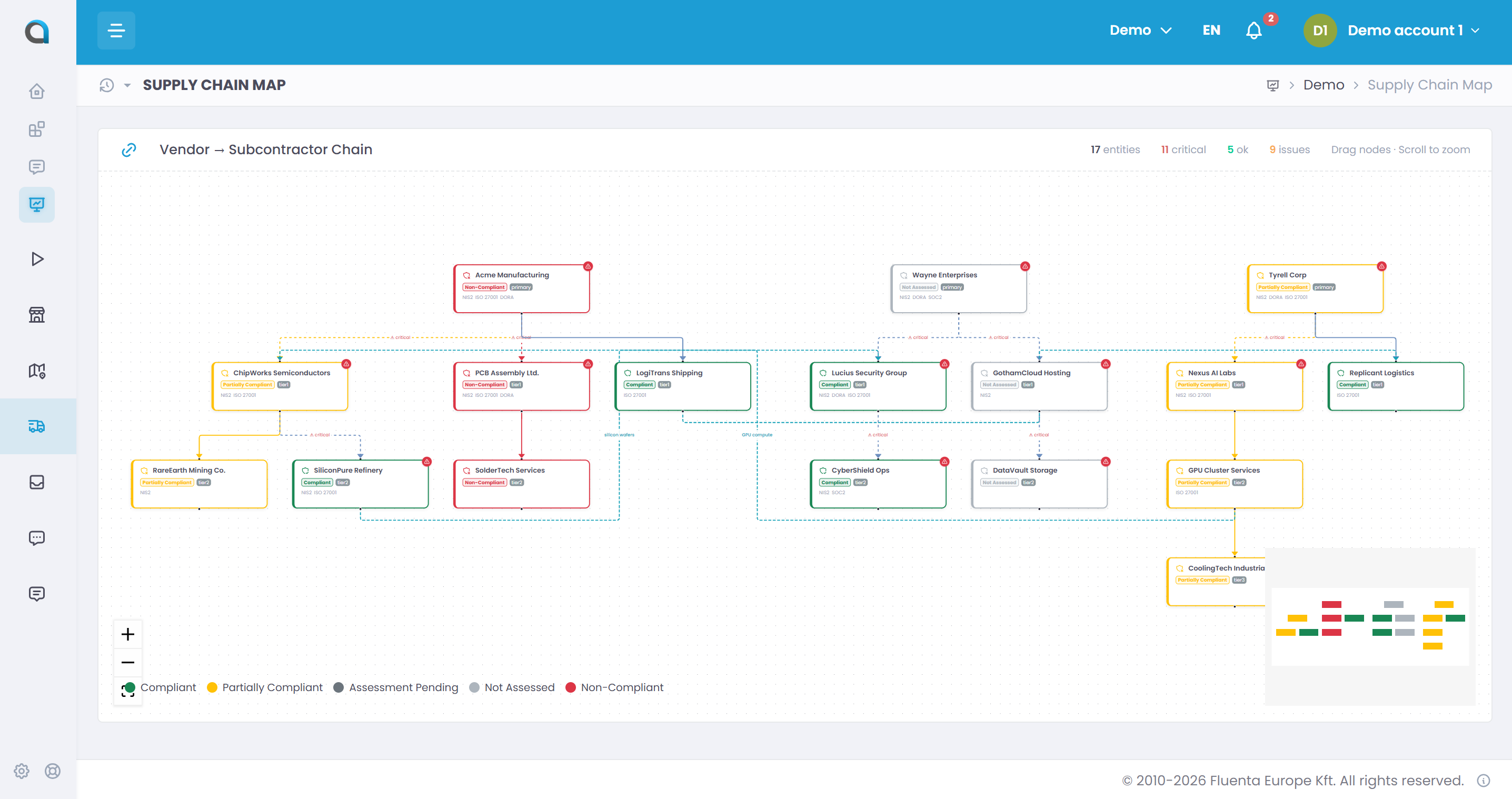
Full supply chain

Risk assessment does not stop at primary partners.

deal tracking
KEY Features

Vendor management features

user information icon

Vendor master data management

Centralized database: bank accounts, tax IDs, certificates, insurance policies, and contacts in one place.

deal tracking

Vendor self-service portal

A browser-based portal where vendors can independently maintain their own data.

pipeline management

Risk assessment

Multi-dimensional evaluation covering financial, compliance, and cybersecurity aspects, with automatic classification.

reporting dashboard

Bidirectional ERP integration

Real-time synchronization via REST API or SAP RFC connection, without manual data copying.

reporting dashboard

Performance scorecard

Freely definable KPIs with automatic scoring calculated from integrated data.

meeting scheduling

Review workflows

Configurable periodic reviews with automatically compiled summaries.

email tracking

Vendor classification

Automatic categorization by spend level, strategic importance, risk level, and source dependency.

email tracking

SLA management

Real-time tracking, automatic alerts, and escalation workflows in case of issues.

email tracking

Reporting

Automatic report generation: aggregated performance, trends, risk statements.

See how AI-powered
vendor management works

with Fluenta One

If you're interested in Fluenta One's vendor management module, get in touch. Book a personalized demo.

Let's talk
support icon
FAQ

Frequently Asked Questions about Vendor Management

01

How is the vendor onboarding process structured?

Vendors complete registration and data submission through a self-service portal. The process steps are: registration → data collection → verification → approval. Documents (certificates, insurance policies, financial statements) are entered into the system in a structured format, and approval takes place through a multi-stakeholder workflow.

02

How does performance evaluation work?

KPIs are freely definable: delivery accuracy, quality compliance, price competitiveness, flexibility, compliance, and financial stability can all be measured. Scores are calculated automatically from integrated data — without manual intervention. The system supports parallel evaluation models (e.g., Satisfactory / Adequate / Unsatisfactory), and performance history provides an objective basis for contract renewal negotiations.

03

How does the platform manage SLA compliance?

SLAs can be defined for delivery time, quality, and response time. The system tracks compliance in real time and sends automatic alerts in case of deviations. The escalation workflow launches immediately, penalty calculations are performed automatically, and historical SLA reports can also be used for audit purposes.

04

How do periodic vendor reviews work?

Review processes can be configured on annual or quarterly cycles. The system automatically compiles the performance, risk, and compliance summary based on predefined templates. The multi-stakeholder, weighted approval process concludes with recorded action points — including re-qualification and offboarding workflows.

05

How is vendor classification structured?

The system categorizes automatically based on four criteria: spend level, strategic importance, risk level, and source dependency. Critical vendors are identified based on a combination of spend, product criticality, and single-source dependency. Classification determines segment-specific workflows and SLAs, and updates dynamically when a vendor's situation changes.

BLog posts

Read our newest articles