
HOW FLUENTA ONE CONNECTS

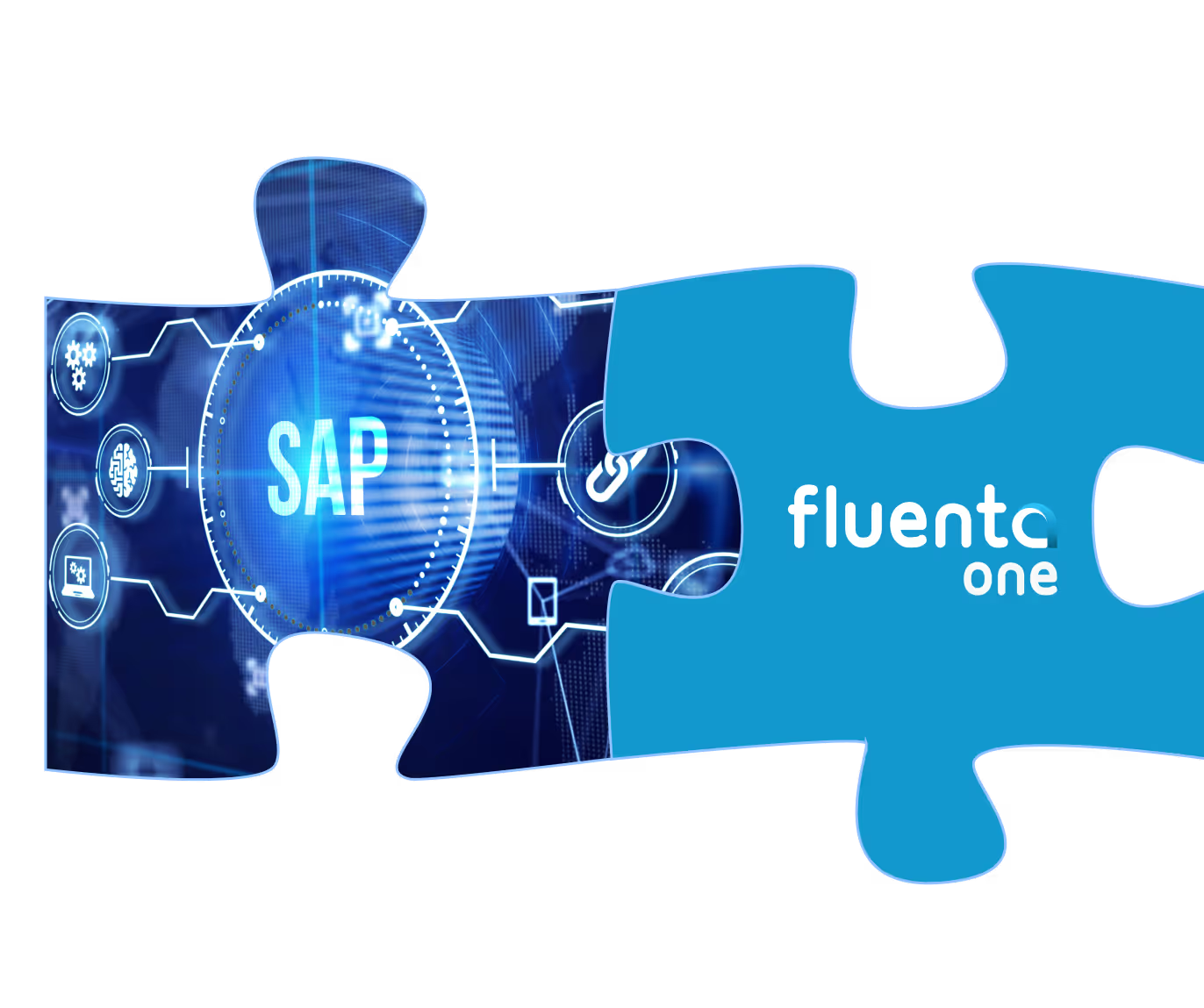
Fluenta One + SAP:Business agility built on a solid ERP foundation

Don't let integration anxiety hold back innovation.
Fluenta One extends the capabilities of your SAP environment while cutting licensing costs and freeing up your IT team.
deal tracking
The real blockers

Three places where SAP integration usually stalls

The missing connector is rarely the problem. The challenges run deeper — and we have a structural answer to all three.
⚙️

Technical complexity

SAP speaks its own language — BAPIs, IDocs, RFC calls. Working with them requires specialized SAP expertise that most in-house development teams simply don't have. Bringing in external SAP consultants is expensive and slow.

💰

Unpredictable licensing

Under SAP's Digital Access model, every external system that creates a document in SAP generates a licensable event. The more direct connections you have, the harder it becomes to forecast licensing costs — and the greater your audit exposure.

🔒

Architectural rigidity

When every application talks directly to SAP, SAP becomes the transactional engine for your entire IT landscape. Rolling out a new portal or application takes months, and a significant share of IT capacity gets consumed by maintaining point-to-point interfaces.

deal tracking
The architecture

SAP stays the 'digital core'.
We're the smart middle layer.

Fluenta One doesn't replace SAP. We operate alongside it as a System of Engagement — taking ownership of workflow orchestration while SAP remains what it does best: a reliable system of record.
  • 🎯

    Decoupled business processes

    User-facing applications don't need to understand SAP's internal workings. They communicate through standard APIs — Fluenta handles everything underneath.

  • 📦

    Consolidated transactions

    Instead of writing to SAP at every step, we gather the results of each stage and push a single, validated data package at the end of the process. This directly reduces the number of licensable documents.

  • 🔄

    A flexible future on a stable foundation

    Any external system can be swapped out or extended without rebuilding the SAP integration. And when the time comes to migrate to S/4HANA, you won't be forced into it — business processes are already decoupled from the technical layer.

Fluenta One – SAP integration architecture Desktop Workstation Mobile Suppliers incoming requests Fluenta One orchestration layer Middleware · Anti-Corruption Layer · Buffer API Gateway & Buffer BPMN Workflow Engine Event buffer Consolidation consolidated transactions Standard API Standard SAP connection SAP S/4HANA or ECC Core master data & finance System of Record
integrations icon
  License optimization

How Fluenta One reduces your SAP Digital Access costs

Under SAP's Digital Access model, every externally triggered document segment — sales orders, procurement records, and so on — is a licensable event. Architecture decisions have a direct impact on that number.

–70%

typical document reduction compared to direct integration

In a typical enterprise scenario, applying an orchestration layer — where sub-process outputs are consolidated before reaching SAP — can reduce the number of licensable documents by 50–90% compared to a naive, point-to-point integration approach.

Important context: Exact savings depend on the SAP modules in use, the nature of the processes, and transaction volumes.

Transaction consolidation

Primary strategy

Fluenta One acts as a buffer: it collects intermediate results and sends only the final, validated state to SAP as a single consolidated package — not at every intermediate step.

Auditable interface boundary

Protection

A well-documented, event-driven architecture draws a clear, verifiable line between SAP and external systems — a position you can defend if an audit comes knocking.

Predictable license costs

Planability

Because you know exactly when and what kind of event hits SAP, licensing costs become foreseeable. No billing surprises, no retroactive audit risk.

integrations icon
Technical connectivity

How we connect to SAP

For IT decision-makers: the specific connection methods, protocols, and integration patterns that govern communication between Fluenta One and SAP.
🌐
+

Modern API layer

Real-time, cloud-friendly communication over modern protocols

REST API OData v4 JSON S/4HANA ready

SAP S/4HANA and more modern ECC configurations expose OData APIs, which Fluenta One uses to communicate via standard HTTP-based calls. This delivers the best performance in cloud-based and hybrid environments.

🔌
+

Legacy SAP connectivity

Full support for older ECC systems

IDoc BAPI RFC ECC 6.0+

We communicate fully with SAP's traditional interfaces — IDoc (Intermediate Document), BAPI, and RFC calls. No SAP-side development or ERP upgrade is needed to establish the connection.

+

Event-driven architecture

Buffered, asynchronous communication to optimize SAP load

RFC / BAPI Webhook Delta sync Async

Fluenta One uses asynchronous, event-driven communication toward SAP (RFC/BAPI) and receives feedback from SAP via webhook or delta synchronization. Transactions bound for SAP can be buffered and consolidated — keeping ERP load consistent and predictable.

🏗️
+

Integration framework

Open, extensible architecture built on industry-standard patterns

EIP patterns SAP-compatible Open architecture

Fluenta One's integration layer is built on industry-standard Enterprise Integration Patterns (EIP), ensuring predictable behavior and long-term compatibility — without requiring additional software to purchase or operate.

deal tracking
Process transformation

Before and after: what Fluenta One actually changes

Process Before (direct SAP integration) After Fluenta One
Request entry Manual data entry by trained administrators. Error-prone, slow turnaround. Requesters enter data themselves in the Fluenta One interface. Validated, structured data reaches SAP.
Faster · Fewer errors
Approval workflow Rigid SAP approval chains. Any change requires a lengthy development project. Flexible BPMN-based workflow engine. Business processes can be modified in minutes — no SAP development needed.
No-code configuration
Vendor data management Manual vendor onboarding via SAP transactions. Ties up IT capacity, slow. Self-service vendor onboarding portal. Approved data syncs to SAP automatically.
Self-service
Integration landscape Dozens of custom point-to-point connections — maintaining them consumes a large share of IT capacity. Business applications talk to Fluenta One, not directly to SAP. A small number of well-defined interfaces replace the previous web of custom connections.
Simplified architecture
Licensable events Every individual step generates a separate document event. Unpredictable, growing licensing costs. Only the final, validated result reaches SAP as a single consolidated event.
50–90% document reduction
deal tracking
Data ownership strategy

Who owns what? Clear boundaries, reliable systems.

SAP remains the single source of truth for financial data. Fluenta One is solely responsible for the workflow layer.
Source of Truth

SAP ERP / S/4HANA

  • Financial documents and general ledger
  • Primary source for item master data
  • Vendor and customer master records
  • Accounting transactions
  • Manufacturing and materials management records
System of Engagement

Fluenta One

  • Workflow status and approval chains
  • Vendor self-service and onboarding process
  • Request and application processes
  • Non-financial specifications and communications
  • Process performance data and dashboards

Compatibility with legacy systems

If your existing SAP environment includes systems without a modern API — such as older archival databases — Fluenta One can work with a decoupled, synchronized database replica, without any changes to the SAP architecture.

No-pressure conversation.Concrete answers.

Tell us about your SAP environment.
We'll show you exactly how Fluenta One fits in — no strings attached.

Let's talk
Blogposts

Read our newest articles