
.png)
In brief: More than half of Hungarian adults now use AI regularly and feel confident doing so, yet Hungarian companies rank at the bottom of the EU for corporate adoption. The lag isn't about technology or skills — it's that individual use has never been turned into an organizational capability, leaving "shadow AI" to spread without oversight, quality control, or measurable return. The real opportunity lies in building a framework on top of an already-willing workforce.
There's one figure in the newly released first AI Index Hungary study that we shouldn't just walk past. According to the representative survey, more than half of the adult population (50.4%) are active AI users: they've used an AI tool within the past month. Most of them are comfortable working with it, and there's virtually no technological barrier to speak of. Set against that, Hungary sits at the bottom of the EU when it comes to corporate AI use. In other words, Hungarians as individuals have already let AI into their lives. Hungarian companies, by contrast, haven't let it into how they operate.
Placed side by side, these two numbers show that the country's lag isn't a problem of technology, access, or skills. People know how to use it; organizations just can't fold it in. And that points to an entirely different kind of task.
One figure deserves to be read with some suspicion. The study finds that Hungarians are confident: they feel they understand AI. The report states this on its own terms. But once you put it next to what they actually use it for, the picture gets more nuanced.
Look at where the usage goes. Of active users, 82.2% turn to AI for information lookup, and most use it for learning, writing, and translation. Coding and the more complex applications woven into actual workflows sit at the bottom of the list. So the typical Hungarian user is essentially treating AI as a smarter search engine and a writing assistant. These are real, useful applications — but they touch only a fraction of what these tools can do.
The most telling sign is the ranking of which tools people use. The market clusters heavily around ChatGPT, while Claude gets a mere 1.5%. Claude tends to shine precisely where AI does deeper knowledge work: analyzing long documents, complex reasoning, coding. This comes through clearly in the largest, most authoritative survey of developers, Stack Overflow's 2025 study: Anthropic's Claude models are used mainly by professional developers, not beginners. So if a tool built for deeper work has a negligible share of a given market, it doesn't mean the product is bad. It means that deeper use is itself rare.
Seen from here, the high confidence takes on a different color. For now, that confidence applies to the easy, risk-free tasks — and that's exactly why it's misleading. Users do what the tool is easiest to use for, while the risk surfaces on the management side: it's easy to mistake individual comfort for organizational capability, and to assume the company is where its employees are. There's an interesting contradiction here: people trust their own AI skills far more than they trust the answers they get back. They confidently operate a tool whose outputs they don't fully consider reliable themselves.
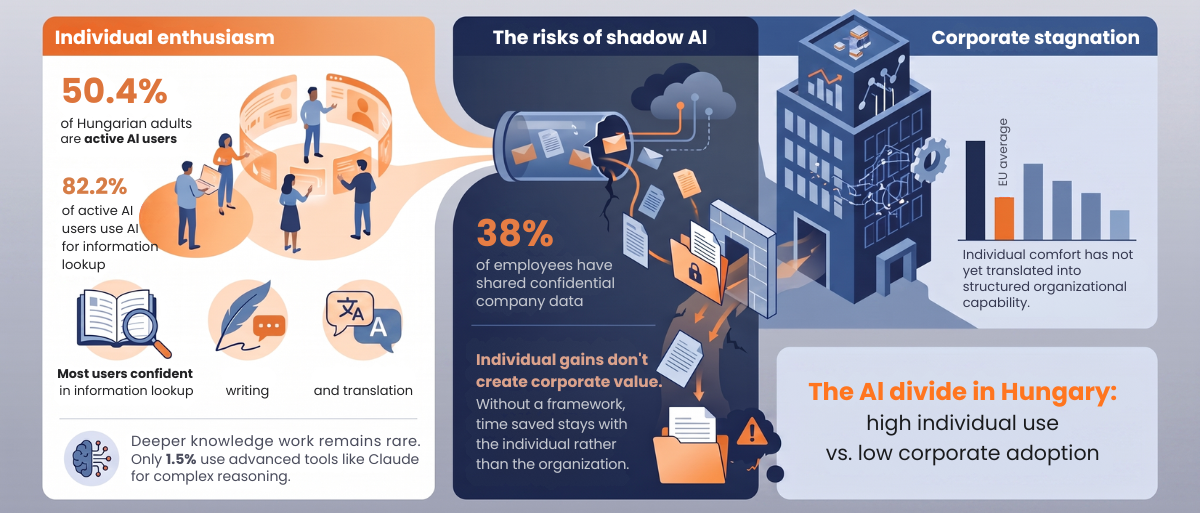
The study's corporate picture confirms this suspicion. At most workplaces there's no AI policy, using AI isn't expected, and only a tiny share of employees have an employer that pays for any kind of AI tool. AI, then, is present inside companies — but as a solo operation, not as a corporate capability. This isn't the employees' fault: they simply want to be more efficient, and there's no framework for them to slot into. The gap is one management has left empty.
This phenomenon is shadow IT, or rather its now-spreading variant, shadow AI. Employees use AI for their daily work on tools they pay for out of pocket or get for free, with no oversight whatsoever, and then the output makes its way into an official process without anyone checking where it came from or how reliable it is. This is a risk not only to quality but to data security: according to Stack Overflow's analysis, 38% of employees have already shared confidential company data with an unapproved AI system. We've explored separately the deeper dynamics of this phenomenon — how it quietly takes over the way a company runs.
The key point is that, appearances aside, shadow AI is no advantage. Knowledge doesn't accumulate: if everyone works with their own tool, the progress stays in the individual's head — and leaves with them. There's no quality control: no one specifies at which point in the process the output gets checked, by whom, and how. And there's no return: the time saved scatters across individual, unmeasured use, so the company never sees it reflected in results.
The most important message of the AI Index isn't the lag itself. That's a fact: Hungarian companies are at the bottom of the EU in corporate AI use, and at the individual level there's ground to make up against the union's frontrunners too. But the numbers' real lesson lies elsewhere — in an internal tension: active, confident individual use stands opposite an organizational uptake that has barely begun. The gap between the two is the real task.
And that gap is worth reading as an opportunity, too. Anyone who already uses AI actively — and half the adult population does — is open to it; the cultural resistance that acts as the biggest brake in many organizations simply isn't present in this group. What's missing isn't willingness, but the framework that strings individual use into a measurable, repeatable corporate practice. Building on existing openness is a different task from starting from zero — provided leadership doesn't mistake enthusiasm for a finished capability.
The research data come from the cited sources; the interpretation of the connections between the data points and the conclusions drawn reflect the author's reading, not the study's explicit claims.
.png)
.png)
.png)




.png)