

In short: Fluenta One’s procurement AI agents help find suppliers, compare bids, process purchase order documents and review contract terms. Multiple specialized agents can contribute to the same procurement process, coordinated by the workflow engine. Company rules define which tasks run independently and where human review or approval is required.
Before supplier offers can be compared, their data needs to be extracted and organized. Before a new supplier can be onboarded, its documentation needs to be reviewed. Before a contract can be approved, any departures from company requirements need to be identified.
Fluenta One’s AI agents take on tasks like these: finding information, processing documents, preparing comparisons and suggesting next steps. They work within procurement workflows, making their output available to the next agent, buyer or approver.
The workflow engine coordinates this work: it determines which task comes next and who receives the result. Company rules govern what happens automatically and where a person needs to review or decide.
An AI co-pilot helps someone process information, prepare a document or evaluate options. An AI agent can also carry out an assigned task independently, using the data and tools it has permission to access.
These roles can overlap. A bid analysis agent, for example, can prepare a comparison independently for a buyer to review and use in a decision. A workflow event, such as a document arriving, can trigger the task without someone having to write a new prompt each time.
When evaluating AI procurement copilots, the practical questions are what work they perform, which information they can access and which actions require human approval.
A new purchase request starts with a question: which suppliers could meet the requirement? The company may already have worked with a suitable supplier, but its performance records and previous contracts may sit in separate systems.
A supplier discovery agent can search accessible internal records to identify potential suppliers against specified criteria. Connected external sources can also support the search for new suppliers and their preliminary assessment.
Criteria might include business activity, location or company size. The result is an initial supplier list that procurement can use for further verification and qualification.
To assess that list, buyers also need to understand where the information came from, how current it is and what still needs to be checked.
One supplier sends a PDF, another a spreadsheet, and a third puts its terms in an email. Before comparing the offers, the buyer needs to organize the information into a consistent structure.
A bid analysis agent extracts the relevant data, compares prices and commercial terms, and highlights significant differences.
The assessment can extend beyond the purchase price to shipping costs, payment terms and warranties. Total cost of ownership, or TCO, also considers costs associated with using the purchase. A meaningful calculation requires the relevant data and agreed assumptions.
Missing information needs to remain visible. If an offer does not specify a delivery charge, that does not mean delivery is free. It remains an item to clarify.
This lets the buyer focus on evaluating differences and resolving open questions, with less time spent assembling the comparison manually.
Data from purchase order documents often needs to be entered into a business system manually. Different formats and incomplete information can create additional follow-up work.
A document-processing agent identifies and extracts the required data, then prepares it for the next workflow step or a connected enterprise resource planning system, or ERP. Data transfer follows the configured integration and validation rules.
If information is missing or unclear, the workflow can specify who needs to clarify it and what must happen before processing continues. Extraction, review and transfer then become parts of one traceable process.
When reviewing a contract, procurement and legal teams need to identify terms that depart from company requirements. If several versions have been exchanged, they also need to understand what changed during negotiations.
A contract analysis agent can help review terms, identify deviations and prepare suggested amendments. The responsible specialist checks the output and decides which terms are acceptable.
Dates extracted from the document can also support ongoing contract management. A renewal or termination deadline, for example, can trigger a reminder and a review task. AI helps interpret the document, while the configured workflow handles notifications and task assignment.
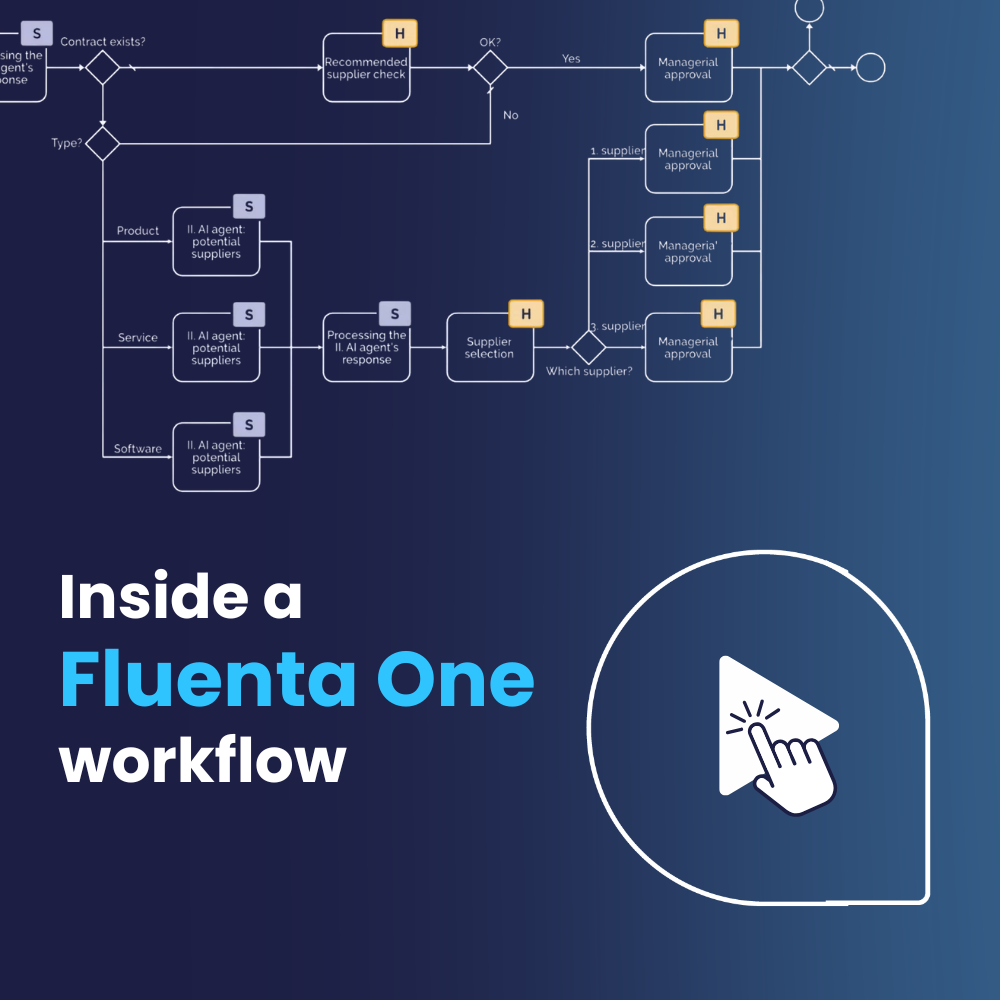
These tasks can build on one another within a procurement process. In an illustrative workflow, supplier discovery results inform the preparation of a request for quotation. Another agent processes the incoming bids, and the comparison goes to a reviewer. The contract associated with the selected offer then moves through a separate review step.
Multi-agent procurement means that specialized AI agents contribute to a shared process and can use one another’s output. Independent tasks can also run in parallel.
In Fluenta One, the workflow engine coordinates this collaboration. It defines task order, data handoffs and human decision points. A separate coordinating AI agent is not required.
The process also includes rule-based automation and system integrations. Assigning an approver or sending a deadline reminder can follow a predefined rule, while interpreting the wording of an offer may involve an AI agent.
For a closer look at how these elements fit together, see inside a Fluenta One workflow.
Information needed for procurement may be spread across supplier records, contracts, bids and the ERP. Each agent’s task therefore needs a defined set of data sources it is allowed to use.
Fluenta One connects with existing business systems to make relevant information available within workflows. Information extracted from documents can be reused as structured data, while discussions can stay linked to the relevant request or decision.
For example, reviewing an offer may require the purchase request, the supplier’s proposal and the terms of an existing framework agreement. Making these available to the reviewer reduces the need for separate searches and information requests.
If your goal is to unify procurement data and automate daily tasks, these connections need to be defined carefully. Which system holds the authoritative record? Who can access it? How are updates shared?
The configured integrations determine which information is available and which actions agents can perform.
Autonomy needs to be defined task by task. Extracting information from a document, recommending a supplier and authorizing expenditure carry different responsibilities.
An agent might prepare a bid comparison without separate approval, while supplier selection and spending authorization remain with designated decision-makers. The same workflow can combine tasks with different levels of automation.
When assessing multi-agent autonomous procurement software, four questions help make those boundaries clear:
These rules establish what agents are assigned to do and what employees remain responsible for.
A useful starting point is a recurring task with accessible data and clear acceptance criteria. Preparing bid comparisons or processing purchase order documents can be suitable examples.
Before implementation, establish how much time the task takes, how much correction is needed and how often missing information requires follow-up. Use the same measures afterward to assess the change.
Track total turnaround time as well. If bid preparation becomes faster but approval still takes several days, you can see both where automation helped and which step needs further attention.
Which procurement tasks can Fluenta One’s AI agents support?
Examples include supplier discovery, bid processing and comparison, purchase order data extraction, and contract review. The specific tasks are configured around the company’s processes, data sources and review requirements.
Is Fluenta One a multi-agent procurement AI platform?
Fluenta One supports multiple specialized AI agents working within the same process. They can build on one another’s output or carry out independent tasks in parallel. The workflow engine coordinates their work alongside other automated steps and human tasks.
Can procurement AI agents make purchasing decisions independently?
Their authority depends on company rules and workflow configuration. Information processing and recommendations can be automated while supplier selection, contract acceptance and spending decisions remain subject to human approval.
Does Fluenta One require replacing the existing ERP?
Fluenta One can work alongside existing systems through integrations. Implementation defines the data exchanged, how it is updated and which tasks each system handles.
Explore request handling, reviews and approvals in the Fluenta One demo, along with the options for adapting workflows to your processes.