

.png)
In the corporate environment, the presence of manual workflows often goes unnoticed, but it can pose significant risks to a company's operations. Simply digitalizing these processes is not a complete solution.
Companies must fundamentally rethink their operating models to fully leverage the opportunities that automation provides. Manual processes inherently limit scalability, increase error rates, and undermine competitiveness in a business landscape where agility and accuracy are critical to maintaining a strong market position.
The error rate in manual data entry is significantly higher than in automated systems, even when using well-trained staff. Identifying and correcting these errors requires a considerable investment of time. The financial consequences of human errors extend far beyond immediate correction costs - they can lead to incorrect orders, inaccurate invoicing, and delayed responses, gradually eroding customer trust and ultimately resulting in customer loss over the long term. Additionally, data errors can incur regulatory sanctions and cause reputational damage, both of which can have a significant negative impact on the company's market value.
One of the most critical consequences of manual processes is productivity loss. Employees often spend the majority of their time on repetitive tasks that do not create new value. This issue is even more pronounced at the management level, where a significant portion of their time is consumed by cross-functional processes that are largely manual. As a result, management is frequently distracted from focusing on strategic decisions due to administrative tasks.
An often overlooked aspect of the strategic costs associated with manual processes is slow decision-making, which hampers the organization's ability to respond to a rapidly changing market. In an environment where real-time information is vital for maintaining a competitive advantage, this represents a serious drawback. Companies that use automated systems can make decisions much faster and respond more quickly to market changes.
Perhaps the most critical strategic impact of manual processes is the limitation on scalability - human capacity becomes the bottleneck. This business model allows only for linear growth, meaning the company can expand only by significantly increasing the workforce. As growth continues, operational overload can occur, where existing processes struggle to keep pace with expansion.
The regulatory environment is increasingly complex, posing significant challenges for organizations relying on manual processes. Manual compliance efforts are particularly costly, leading to a much higher number of violations, often due to inadequate documentation. Additionally, high employee turnover increases costs further, as training new staff requires substantial time investment.
In today's business landscape, success depends on operational speed and agility. Organizations that rely on manual processes face a structural disadvantage compared to competitors utilizing automated systems.
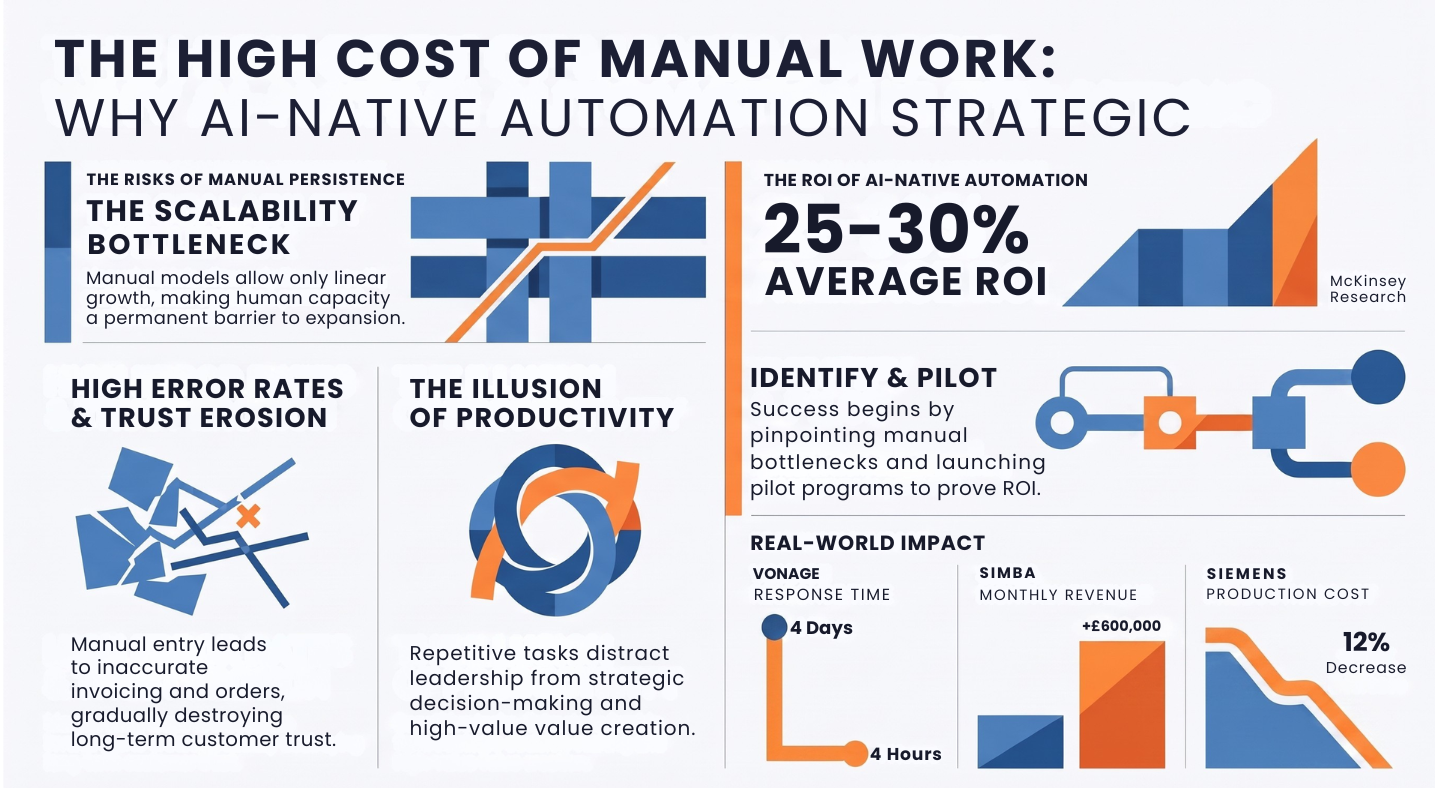
Real corporate examples clearly illustrate the practical benefits of process automation:
The financial results from these examples clearly support the value and importance of investing in automation. According to research from McKinsey, companies that enhanced their processes with AI-based automation reported an average ROI of 25-30%.
Automated systems are particularly effective because they not only speed up existing processes but also create new revenue opportunities by freeing up human resources for higher-value activities. This leads to increased productivity and improved customer satisfaction.
1. Identifying bottlenecks
Begin by pinpointing critical areas where manual work is routine, carries a high risk of error, and directly impacts corporate performance.
2. Building trust through proof
Before implementing changes on a large scale, consider starting with pilot programs. These programs are designed for rapid concept validation. Achieving early, measurable successes not only demonstrates a return on investment but is also essential for convincing internal skeptics and maintaining the project's long-term momentum.
3. Controlled scaling and developing internal competence
After experiencing initial successes, responsible scaling can occur. This phase should focus on two parallel pillars:
4. Human-centered change management
The technical implementation should be accompanied by transparent communication throughout the organization. To overcome digital resistance, employees must be engaged as active participants in the decision-making process, rather than passive recipients of change. The aim of automation should be to enhance employee roles, not replace them, thereby freeing them to focus on value-creating tasks.
The risks associated with manual processes are evident across various areas, including the direct costs of human errors, productivity losses, and the decline of long-term competitiveness. These risks are interconnected, leading to an operational environment that is vulnerable and challenging to scale.
If you have identified the risks related to your company’s manual processes and are ready for change, it might be beneficial to explore how the Fluenta One platform can facilitate your digital transformation. Our AI-native workflow automation solution is specifically designed to optimize business processes and minimize hidden costs.
Would you like to discover how these solutions can be implemented in your company? Contact us, and let's discuss how we can assist you in effectively automating your manual processes.
.png)
.png)
.png)