

In brief: Fluenta One is an intelligent workflow platform built on reusable "microprocesses" instead of rigid modules. It connects existing systems (ERP, CRM, document archives), runs AI agents at three levels of autonomy (supportive, collaborative, autonomous), and manages contracts, exceptions, and cross-partner workflows from a single place. The result: process changes that used to take months now take days, with fewer errors and full audit traceability.
One of the biggest challenges for modern companies is that their existing systems cannot keep pace with business needs. Implementing a process change takes months, different departments' systems operate in isolation, and valuable information is stored scattered and difficult to access.
The Fluenta One platform is an intelligent workflow system that brings a new approach to enterprise workflows through its microprocess architecture and AI support. It connects existing systems, automates routine tasks, and enables changes to be implemented in days – not months. The result: drastically reduced costs, faster processes, and a platform that can finally work at the company's pace.
Fluenta One is not another ERP system. It's not a project management tool. It's not document management software. And yet it's all of these combined.
Fluenta One is an intelligent workflow platform that redefines how business processes work. Instead of thinking in modules (procurement, HR, legal), the platform thinks in processes – regardless of which department is responsible for them.
Think of LEGO: each brick is simple on its own, but through their combinability, almost any construction can be built from them. Fluenta One does the same with business processes: it breaks down every process into microprocesses – small, well-defined units. These operate independently with their own logic and rules, can be arbitrarily connected into new processes, and are reusable in different contexts. A "partner financial verification" microprocess, for example, can be used in procurement, sales, marketing, and HR alike. The same logic in different contexts – this is what true reusability means.
This microprocess-centric thinking gives Fluenta One its flexibility. But what does this mean in practice? How do AI, integration, and automation work together? In the following sections, we'll walk through the platform's main capabilities: different levels of AI agents, API-first integration, intelligent document management, contract creation, exception handling, and performance tracking.
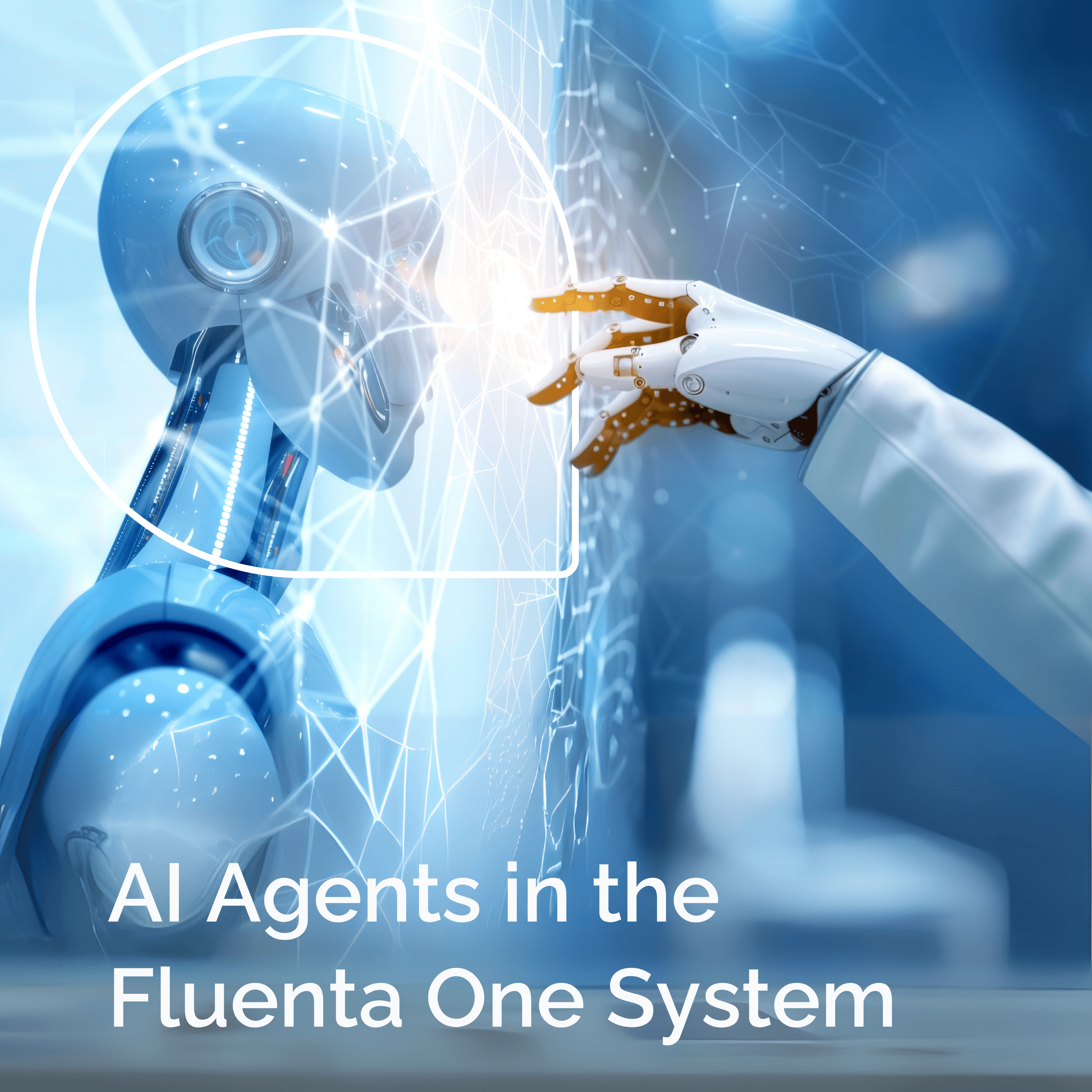
Most AI solutions are tools: we use them when needed. Fluenta One's AI agents behave like employees – embedded in workflows, they act independently according to defined rules.
In the Fluenta One system, the level of automation can be set for each microprocess, which is not just a technical detail but a strategic decision. At the supportive level, AI puts tools in people's hands – templates, databases, quick access to previous contracts. It helps, but doesn't act on our behalf.
At the collaborative level, AI actively participates: it makes suggestions, alerts, works with us. For example, AI generates a contract draft, but a human reviews and approves it. This level combines human judgment with machine efficiency.
At the autonomous level, AI independently executes routine tasks based on defined rules. It automatically reconciles invoices with orders and only alerts when it finds a discrepancy. Human attention can focus on truly important decisions.
Fluenta One doesn't operate in isolation. Thanks to its API-first architecture, the platform is fundamentally designed to communicate with other systems – ERP systems (SAP, S4/HANA, Oracle), CRM solutions (Salesforce, HubSpot), inventory databases, contract repositories, and archived documents alike.
When searching for an alternative raw material supplier, the AI agent first searches the internal database – reviewing previous contracts, offers, and performance data. If it doesn't find a suitable partner, it automatically continues the search on the internet.
If a system doesn't have a modern API (for example, a 15-year-old archive database), Fluenta One can work with a detached, synchronized database copy.
A distinctive feature of Fluenta One is its ability to create workflows spanning across organizations, allowing partner organizations to participate in processes. Since efficient operations are a mutual interest, the platform integrates both parties' work into a single process – all data and communication remain in the same context. The external partner (e.g., supplier) can also create their own processes on their side: assign tasks to departments, apply internal rules and approvals, after which the workflow seamlessly returns to the customer where it started. Every step is automatically documented, the entire process remains traceable – this means both efficiency and audit security.
A company has 5,000 scanned contracts in various languages, in poor-quality PDFs, in non-standardized formats. Answering a simple question – which partners have contracts expiring next year – would take weeks using traditional methods.
Fluenta One processes documents in a multi-step process: OCR extracts text even from poor-quality documents, AI image correction improves scans, then structured data extraction identifies key information – partners, dates, amounts, terms. It assigns a confidence score to each piece of data, so with a single query you can see which contracts had low confidence levels (for example, below 70%), and these can be validated separately.
During processing, every document becomes a business artifact – structured, independent, business-value-delivering, AI-interpretable data that, alongside the original format (e.g., scanned image, PDF, JSON, financial statements, reports, data tables, etc.), also contains metadata and other structured data. This enables AI processing of this information, which eliminates a lot of manual, low-value-added research work. This significantly speeds up processes, supports decision-making, and reduces the risk of errors through automatic alerts.
Multilingual document handling is supported by language-specific analyzer modules – linguistic diversity increases complexity but doesn't represent a technical limitation.
Creating a new contract with a supplier is traditionally a fragmented process: searching for partner data in different systems, checking financial status, selecting a template, then emailing the draft for approval, searching for partner modifications with change tracking, finally signing and archiving in separate systems again. The process can take weeks, it's easy to make mistakes, and information can be lost between systems.
Fluenta One manages the complete lifecycle on a single platform. The AI agent collects partner data from all relevant systems, performs risk analysis and compliance checking, then generates the draft with personalized terms. The partner can also submit modification requests within the platform, which the AI evaluates and advises on. After acceptance, the approval workflow automatically guides the document through the necessary steps – handling multiple approvers in parallel if needed – then the platform archives and makes it trackable. The entire process takes place on one platform, potentially reducing the time required to hours.
The AI agent automatically uses the latest template version, doesn't forget mandatory clauses, automatically checks numerical relationships, and alerts to contradictory terms. AI-supported contract creation can reduce contractual errors by up to 95%. Intelligent contract creation manages the complete lifecycle – from drafting through negotiation to approval – on a single platform.
Traditional thinking suggests that 80% of processes are standard, 20% are exceptions. This is misleading because that 20% often contains the decisions with the greatest strategic and financial impact. At a larger company, 15-25% of procurement transactions require individual handling, consuming significant manual coordination and time.
Fluenta One doesn't think in "standard + exceptions" logic, but in rule-based routing. For example, in an emergency procurement, the system automatically recognizes the situation and initiates an expedited route: immediately directs to the procurement manager, notifies finance in parallel. Lead time drops from 1-2 days to 2-4 hours.
What companies often call "exceptions" are actually easily manageable alternative routes. Some examples of what Fluenta One can handle:
Process-level deviations: single-source procurement (when only one supplier exists), emergency situations, contract extensions. These are legitimate alternative routes, not errors.
Transaction-level deviations: 299 boxes arrive instead of 300. The system can define tolerance limits (e.g., ±2% or maximum 50 EUR), leading to automatic approval if the deviation is within the acceptable range.
Policy exceptions (maverick buying): the best countermeasure is a system where the official route is faster than the workaround. The goal of exception handling is to make regulated flexibility automated.
Tracking targets defined in sales contracts based on incoming orders is a serious challenge when data is scattered: orders in the ERP, contracts in legal document management, performance reports in the CRM.
Fluenta One solves this with horizontal processes. These are automated processes that span across different systems. They continuously monitor incoming orders, compare them with contractual targets, flag deviations, and notify when intervention is needed.
Data collection can happen through partner-side automatic reporting or direct queries by Fluenta One from different systems. The dashboard shows in real-time which partners are meeting targets to what extent – without having to log into different systems.
In traditional ERP systems, a minor rule change takes months: specification, development, testing, deployment – approximately 14 weeks.
Suppose a procurement process consists of 37 microprocesses. If new legislation makes ESG audits mandatory, in Fluenta One you simply insert the ESG evaluation microprocess in the appropriate place – and the process now consists of 38 microprocesses. The modification is quick and simple. Time required: 2-5 days.
Every modification first occurs in a test system. The system checks what impact the change has on other processes, then goes live after approval. The microprocess architecture minimizes chain reactions – the test system helps identify if a modification might affect other microprocesses.
According to the Zero Trust principle, every user only has access to the data and functions necessary for their task. Role-based access control can be integrated with the company's Active Directory system. Every action is logged – who did what, when, why – with automatic timestamps and a complete audit log.
Compliance requirements (GDPR, ISO 27001, industry-specific regulations, such as GxP in pharmaceuticals) are fully supported. The system can run in the company's own environment, ensuring that sensitive data doesn't leave the company.
Process Time: Procurement is 30-70% faster, contract creation drops from 2 weeks to 2 hours, invoice processing is accelerated by 78%.
Manual Work: Administrative tasks decrease by 40-60%, exception handling requires 75% less time.
Error Rate: Automated processes have 80-90% fewer errors, contractual errors decrease by 95%.
Compliance: Audit compliance is 99.9%, response time to audit requests drops from days to minutes.
ROI: Average 60-70% TCO savings, 90% shorter development time, implementation of changes is 85% faster.
Fluenta One doesn't promise to solve every business problem. But it does promise that virtually any business process can be modeled, automated, and integrated on the platform. And this isn't marketing – it's the natural consequence of the microprocess philosophy.
The difference is simple: the traditional approach created static documentation and fixed software that was expensive and time-consuming to modify. Fluenta One builds living, executable processes capable of continuous adaptation.
Previously, months passed from planning to execution, now we get from specification to live system in days. In a rapidly changing business environment, adaptability is a competitive advantage. Fluenta One doesn't just enable change – it makes it safe, predictable, and efficient.
Would you like to see how all this works with your processes? Discover how Fluenta One can support your company's operations.
.png)
.png)
.png)



.png)
