
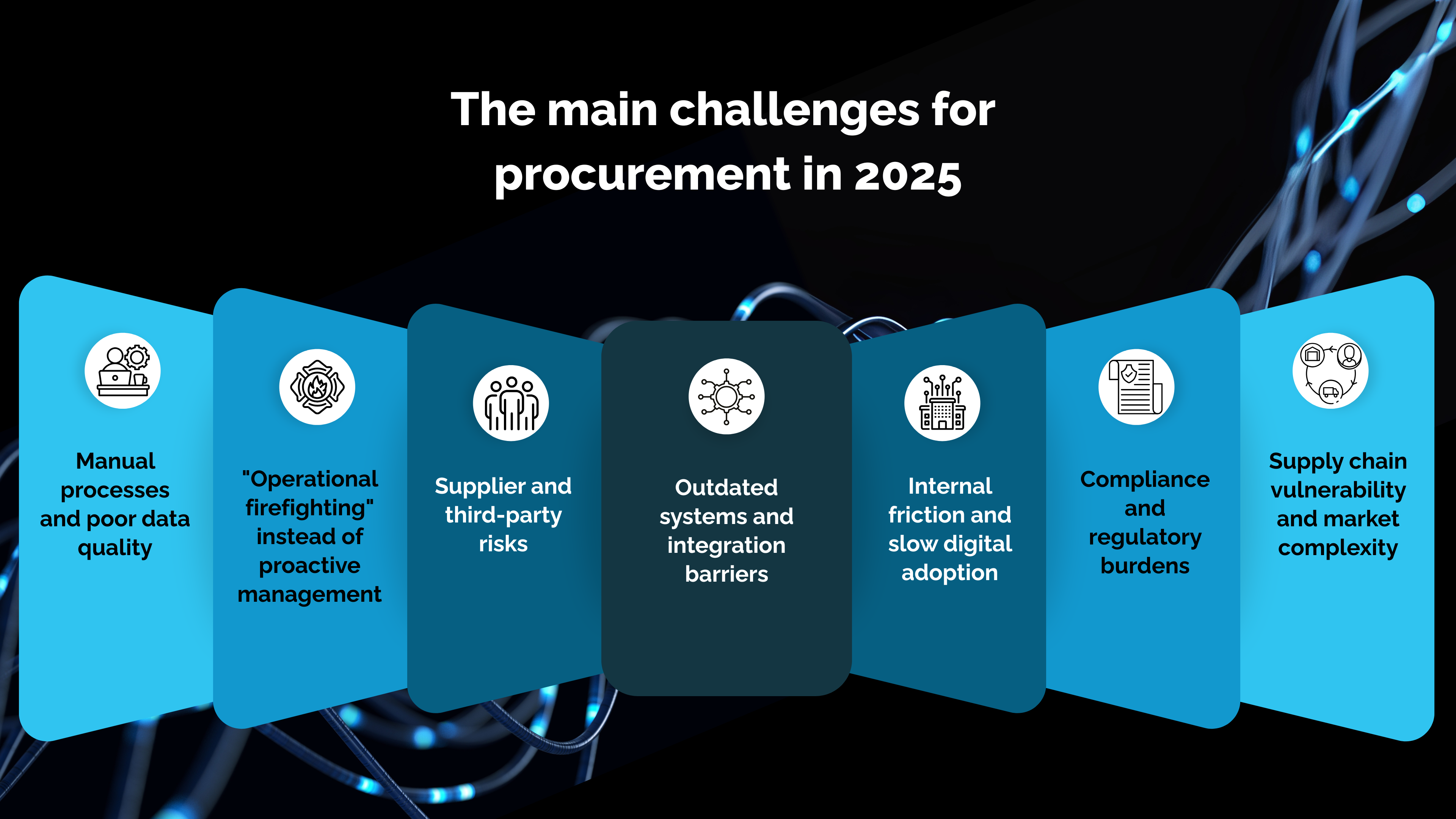
In brief: Procurement teams across every industry face the same seven structural challenges: manual processes and poor data quality; operational firefighting instead of proactive management; hidden supplier and third-party risk; outdated, disconnected systems; internal friction and slow digital adoption; a tightening compliance and ESG burden; and growing supply chain vulnerability. The common thread is a lack of transparency, a reliance on manual work, and fragmented systems that never talk to each other. The fix is the right technology: AI-driven automation, real-time unified visibility, clean integration, and automatic compliance tracking that turn these recurring pain points into efficient, transparent processes.
Procurement departments across every industry, from pharmaceuticals and agriculture to banking, are wrestling with the same core challenges. The sector-specific details vary, but the underlying structural problems in procurement processes turn out to be remarkably similar.
Drawing on interviews with procurement professionals across a range of industries, this article identifies seven recurring pain points that teams deal with day to day. Each one undermines operational efficiency and keeps procurement teams from focusing on the strategic, value-generating work they were hired for. Below we look at each challenge and why resolving it matters for long-term business success.
Procurement professionals spend a large share of their working time on low-value administrative tasks such as data entry, document reconciliation, and chasing approvals, by many estimates up to roughly 30%, rather than on strategic priorities. That manual handling is not only slow; it is a primary source of errors and duplicated information.
When data quality suffers, decisions get made on faulty assumptions, and genuine sourcing opportunities slip past unnoticed. Manually managed processes also do not scale, so as a company grows, procurement steadily turns into a bottleneck. Automating the repetitive work is what frees up capacity for the strategic, value-adding activities that actually move the needle.
A lack of transparency in the available information makes strategic decision-making difficult. Teams end up trapped in a cycle of operational firefighting instead of doing the strategic work itself. Industry research consistently finds that a majority of organizations lack real-time oversight of their procurement operations and supplier performance, and without that visibility, teams can only react to problems rather than anticipate them.
Because data sits scattered across systems, teams cannot see problems coming and are left managing the fallout. This forces the whole function into permanent reactive mode. It is not only frustrating for the professionals involved but expensive, leading to missed savings, delayed projects, and burnout. A procurement team delivers its full value only when it is free to focus on strategic sourcing, strong supplier relationships, and proactive risk mitigation.
Weak supplier management brings a cluster of dangers: poor visibility into third-party risk, inaccurate risk assessment, hidden costs, and over-dependence on individual suppliers. A single critical supplier failure can set off a chain reaction of production shutdowns, lost revenue, and reputational damage, and single-source dependency is one of the most dangerous vulnerabilities of all, since one event at one vendor can halt operations.
Heavy reliance on a single supplier also weakens negotiating power and the ability to seize new market opportunities. The risk is growing rather than shrinking, as major supply chain disruptions are now occurring far more frequently than in the past. Modern procurement needs real-time risk assessment, continuous performance monitoring, and automated alerts that surface problems before they turn into losses.
Aging technology creates its own set of problems: integrations that never quite work, incompatible systems, and the sheer difficulty of connecting tools that were never designed to talk to each other. A typical company runs several separate, standalone systems for procurement-related activities, and poor integration between them means double data entry, constant reconciliation, and no end-to-end visibility.
That fragmentation stops teams from seeing inventory, spend, or contract status in real time, which in turn blocks proactive value creation. In fact, analysts increasingly argue that fragmented data environments, rather than any shortage of strategy or talent, are the single biggest barrier to strategic procurement. Real-time data flow and full transparency are prerequisites for a procurement operation that runs smoothly.
Internal dynamics create their own drag: slow approval cycles, resistance to new digital tools, and a general wariness of change. When a straightforward requisition-to-order cycle stretches out over days or weeks, the result is not just project delays and strained supplier relationships but a real competitive disadvantage and time cost. Complex approval workflows and long lead times frustrate stakeholders on both sides.
Juggling and constantly reconciling many different digital tools slows teams down further and holds back digital adoption. The key to getting transformation right is a platform people actually want to use, not one more mandatory tool to tick off a list. Intuitive interfaces, automated workflows, and fast approvals can dramatically improve process speed, and by extension the whole procurement operation.
Companies now operate in an increasingly complex regulatory environment, where non-compliance risks lost business opportunities and potentially heavy fines. ESG requirements have shifted from optional extras to baseline expectations from partners, investors, and customers, with a large and growing share of new supplier agreements now carrying ESG reporting obligations.
The regulatory environment keeps tightening and penalties have climbed sharply. Data-protection breaches under the GDPR alone can cost up to 4% of global annual revenue, a scale that turns compliance from a back-office concern into a board-level one. Modern businesses need systems that track and enforce compliance automatically and can produce audit-ready documentation on demand, backed by a complete digital trail.
Recent global events have laid bare just how fragile supply chains can be. A problem at a distant supplier can halt production in Europe within weeks, and geopolitical tension, climate change, and other systemic risks are turning into real, recurring threats. Supply-disruption risk now ranks as a top external challenge for the large majority of procurement leaders.
Companies that cannot anticipate these disruptions are stuck in constant crisis-management mode, an expensive and exhausting way to operate. Real-time visibility and predictive analytics have moved from luxury to necessity for a modern supply chain.
The common thread running through all seven pain points is the same: a lack of transparency, a reliance on manual processes, and a patchwork of fragmented, disconnected systems. The encouraging part is that the right technology can resolve them.
The Fluenta One platform is built to tackle these challenges together:
If you want to see how this works in practice, show us your challenges and we can show you how they become automated, efficient processes.
What are the biggest challenges facing procurement teams? Interviews across industries point to seven recurring ones: manual processes and poor data quality, reactive firefighting instead of proactive management, hidden supplier and third-party risk, outdated and disconnected systems, internal friction and slow digital adoption, a growing compliance and ESG burden, and supply chain vulnerability. They differ in detail by sector but share the same structural roots.
Why are manual processes such a problem? They consume a large share of a team's time, by some estimates up to 30%, on low-value tasks like data entry and chasing approvals, and they are a primary source of errors and duplicated information. They also do not scale, so as a company grows, procurement steadily becomes a bottleneck.
How does poor supplier management create risk? Static, point-in-time due diligence cannot keep up with dynamic risk. A single critical supplier failure can trigger production shutdowns, lost revenue, and reputational damage, and over-reliance on one vendor weakens negotiating power. Major disruptions are also occurring more frequently, which makes real-time monitoring increasingly important.
Why does system fragmentation hurt procurement so much? A typical company runs several separate, standalone systems, and poor integration means double data entry, constant reconciliation, and no end-to-end visibility. Analysts increasingly argue that these fragmented data environments, rather than any lack of strategy or talent, are the single biggest barrier to strategic procurement.
How can these challenges be solved? The common thread is a lack of transparency, manual work, and disconnected systems, all of which the right technology can address. AI-driven automation removes administrative burden, a unified platform provides real-time visibility, clean integration eliminates silos, and automatic compliance tracking keeps documentation audit-ready.
.png)
.png)
.png)





.png)